You can enjoy Park Güell without a guide, and a guided tour gives you no exclusive access: everyone with a ticket walks the same terraces. What a good guide adds is interpretation, not privileged entry. A plain ticket lets you see Gaudí’s work; a guide helps you understand why he built it this way, from the housing estate that failed to the water hidden inside the columns and the bench that Josep M. Jujol designed. If you mainly want photos or your own pace, a plain ticket is enough, and our official tour vs guided tour comparison sets out the other choices.
This page follows the route most groups walk and lists what a guide usually points out at each stop.
Park Güell Tour with Golden Tour Guide
The Monumental Zone and the Route a Group Walks
The Monumental Zone is the core of the paid park. It sits behind a second control point inside the ticketed area, where you may have to wait even with a guide, and it holds the five spots the park regulates most closely: Nature Square, the Hypostyle Room, the Laundry Room Portico, the Dragon Stairway and the Austria Gardens.
Most group tours meet at Carretera del Carmel 23, at the upper, back end of the park (see the meeting point guide). From there the walk runs downhill and, compared with the gate-to-dragon order of most photo guides, backwards. Special Plans (our breakdown) is the only operator that publishes its stops, and its order is Nature Square, the Laundry Room Portico, the Hypostyle Room and then the Dragon Stairway, with the gatehouses below it. One five-star reviewer of the Golden Tour Guide tour wrote: “I was surprised starting the tour from the back. Felt anticlimactic.” Go in knowing that the dragon and the gatehouses come at the end.
Stops vary by operator, by guide and by the works on site. As of the park’s update of November 16, 2026, drainage, lighting and Wi-Fi works due to last about 18 months have closed the path from Coll del Portell to the Forat del Vent stairway and the stretch from Casa Trias to the Upper Viaduct. Ask your guide on the day which stops the route includes.
The Estate Story Behind the Park
Almost every guide starts with the same story, because it explains everything else. In 1900 Eusebi Güell had Gaudí lay out a gated residential estate of “some 60 triangular-shaped plots” on a bare hillside then called Muntanya Pelada. Güell called it “Park” in English, after British garden suburbs, and only a sixth of each plot could be built on.
The estate never took off. The gate pavilions, the stairway and the viaducts were finished by 1903, and the Hypostyle Room was roofed by 1907, but works stopped in 1914 with only a couple of the planned houses built. The city bought the land in 1922, opened it as a public park in 1926, and UNESCO listed it in 1984.
Operator listings promise the same frame in their own words: the “gated community for Barcelona’s elite”, Ildefons Cerdà’s plan and the way Barcelona grew in the 19th century, and the Modernisme building techniques used here. Once you know you are walking through an unsold housing development, the market hall with no market and a porter’s lodge for an estate with almost no residents start to make sense.
Stop by Stop: What a Guide Points Out
The examples below are typical, not a script. Each guide picks their own details.
Nature Square and the serpentine bench
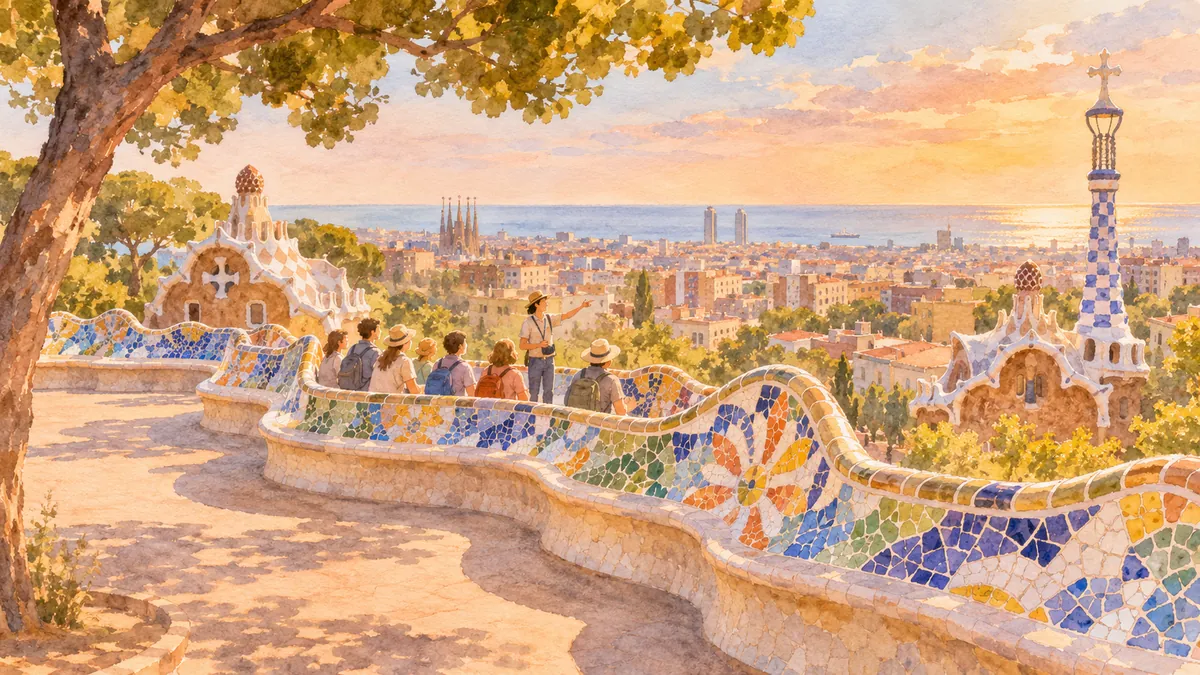
Nature Square, also called the Greek Theatre, is an artificial terrace built for open-air performances. Part of it is cut into the rock and part rests on the columns of the Hypostyle Room underneath. The serpentine bench that curves around its edge, with views over Barcelona, was “planned by Josep M. Jujol”, according to the park’s own pages; Gaudí usually gets the credit, and a good guide corrects that. This is also where you first see trencadís up close: the broken-tile mosaic that also covers the dragon and the ceiling discs below, and a guide will usually show you what the pieces are made of. Sit on the bench, but don’t lie on it or climb on it.
The viaducts and the Laundry Room Portico
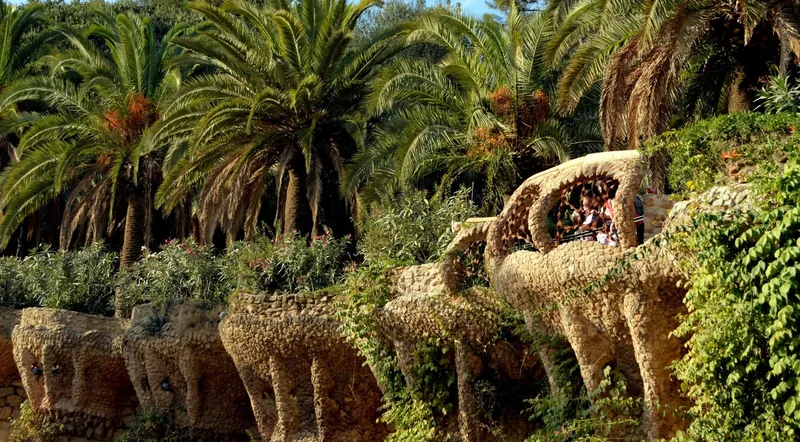
Gaudí designed a 3 km network of roads for the estate, with viaducts whose columns imitate caves. The Laundry Room Portico is the most striking piece: the park describes it as “a great wave atop slanting columns”. It takes its name from the sculpted washerwoman on one column, and a spiral ramp runs down from it to Casa Larrard, the old farmhouse where Güell lived from 1907.
The Hypostyle Room’s 86 columns and the water system
The Hypostyle Room was planned as the estate’s market hall. Its 86 striated columns are inspired by the Doric order, and the outer ones slope; operators like to call it a “stone forest”. The engineering is the part most visitors miss. According to the park, drainpipes hidden in the columns carry rainwater from Nature Square above down to an underground cistern, and the cistern’s overflow comes out of the dragon’s mouth on the stairway below. The hall has three naves, and the round trencadís discs set into its ceiling are Jujol’s work.
The Dragon Stairway salamander
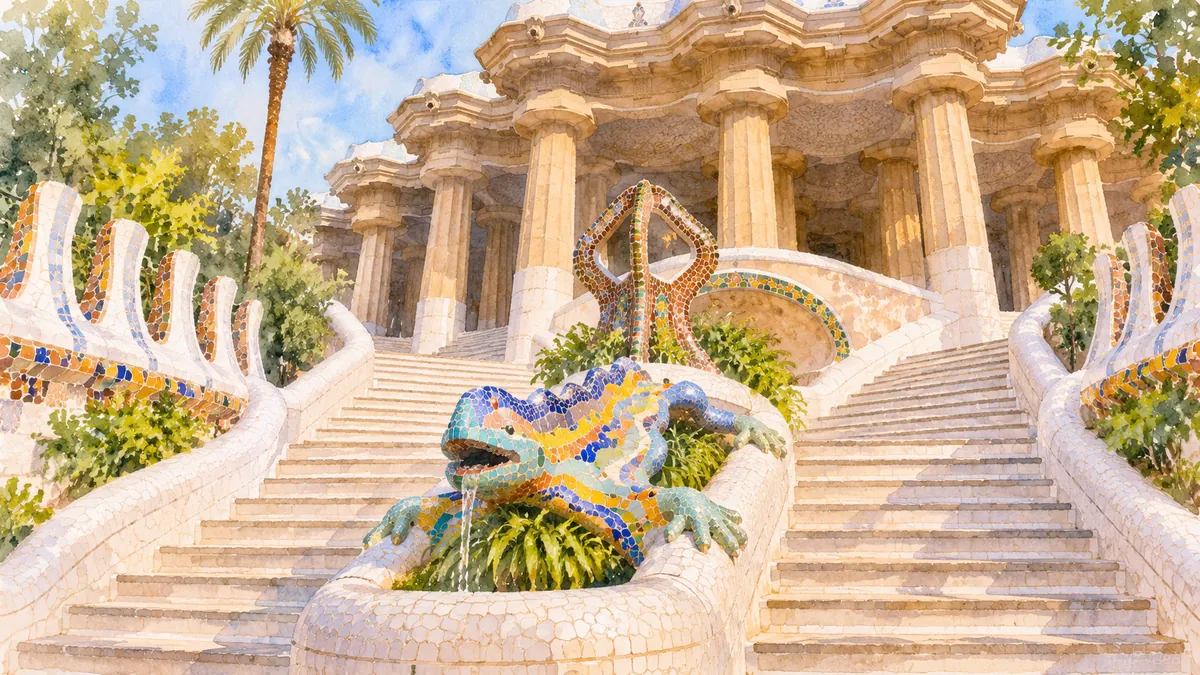
The Dragon Stairway is a twin flight in three sections with a fountain running down the middle. On the way down you pass goblin-like shapes, then the Catalan emblem, then the trencadís creature the park itself calls “the dragon, or salamander”, its most photographed image. What it symbolizes is debated, so treat any single reading as one interpretation. What a guide can show you is that it belongs to a larger system of stairs, terraces and water, not a photo stop on its own. Expect a crowd here at any hour.
The gatehouses
The two gatehouses at the Carrer d’Olot gate have gingerbread-style roofs covered in trencadís, and the palm-leaf iron gates came from Casa Vicens, one of Gaudí’s earlier houses. One lodge was the porter’s lodge and now holds a MUHBA city history exhibition with limited capacity; the other is the Laie shop. Groups that start at the Carmel gate usually reach them last.
Gaudí’s house, the Austria Gardens and the Three Crosses
Gaudí’s house began as the estate’s show house, started by Josep Pardo i Casanovas to plans by Francesc Berenguer. Gaudí’s father bought it in 1906 and Gaudí lived there until 1925; it has been a museum since 1963. The Gaudí House Museum is temporarily closed for maintenance, with no reopening date, and it is not part of any park ticket or guided tour, so a listing that names it can only mean a look from outside.
Beyond the core, the Austria Gardens were estate plots, later a municipal nursery, and take their name from a gift of trees from Austria in 1977. The Three Crosses mark the park’s highest point at 182.30 m, where the estate chapel was meant to stand.
Five Things You May Miss Without a Guide
- The failed residential project: why a park has plots, a show house and a porter’s lodge.
- The Hypostyle Room’s planned use as a market: why a forest of columns stands under a terrace.
- The rainwater collection on Nature Square: where the water goes and why the dragon has a spout.
- Trencadís: what the broken-tile mosaic is made of and where you can see it.
- The nature-inspired forms: how the viaducts, columns and terraces follow the slope of the hill.
How to Judge a Guide on the Day
A good guided tour does five things. It tells the residential-estate story, explains the water system, shows how the design answers the hillside, makes room for asking questions, and leaves you time to look before the group moves on. Lower-rated reviewers mention hearing the guide and a rushed pace more often than a dull guide: read our Park Güell guided tour reviews guide for what to watch for, and the which tour guide to compare operators.
Frequently Asked Questions
Do I need a guide to understand Park Güell?
If you want to know why the park looks the way it does, a guide helps: the estate story, the water system and Jujol’s role are easy to miss on your own. If you mainly want photos, a timed ticket and the park’s free app are enough.
In what order does a guided tour see the Monumental Zone?
Tours from Carretera del Carmel 23 usually walk downhill: Nature Square, the Laundry Room Portico, the Hypostyle Room, the Dragon Stairway and finally the gatehouses. Routes vary by operator and by the current works.
Does a guided tour go inside Gaudí’s house?
No. The Gaudí House Museum is temporarily closed for maintenance and is not included in any park ticket or guided tour.
Who designed the serpentine bench?
The park credits the undulating bench on Nature Square to Josep M. Jujol, who also made the trencadís ceiling discs in the Hypostyle Room. Gaudí designed the park as a whole.
Is the Park Güell creature a dragon or a salamander?
The park’s own description says “the dragon, or salamander”, and both names are in common use. Overflow from the cistern under the Hypostyle Room comes out of its mouth.
Check Park Güell Guided Tour Dates and Prices
The Golden Tour Guide group tour with the park ticket, booked through GetYourGuide. Pick your language and time; free cancellation up to 24 hours before.
Check Guided Tour Prices & Times